1. Why CITES?
Most traditional erhus (mid-to-high tier) use Burmese python skin (Python bivittatus) as the resonator membrane — the standard material for centuries due to its even thickness and warm tone. Burmese python was listed in CITES Appendix II in 2012, meaning while not endangered, international trade is regulated.
- Cross-border transport (including personal carry) of python-skin instruments requires a CITES certificate from the original importing country plus a fresh "Re-export Permit" for each new export
- Risk of not having one: customs can detain, confiscate, or destroy the instrument (even if eventually returned, the python skin's cracking from dry storage cannot be reversed)
- Sources: CITES Appendices / Taiwan Trade Administration
⚠️ Synthetic Skin (PET) Erhus Are CITES-Exempt
In recent years, brands have released synthetic python-skin erhus (Yuanting, Shanghai National Musical Instrument Factory's PET series). Sound quality approaches natural skin and is fully CITES-exempt. For frequent international performers, consider a "travel erhu" with synthetic skin. This article focuses on natural python skin erhus.
2. CITES Re-export Permit — Real Example
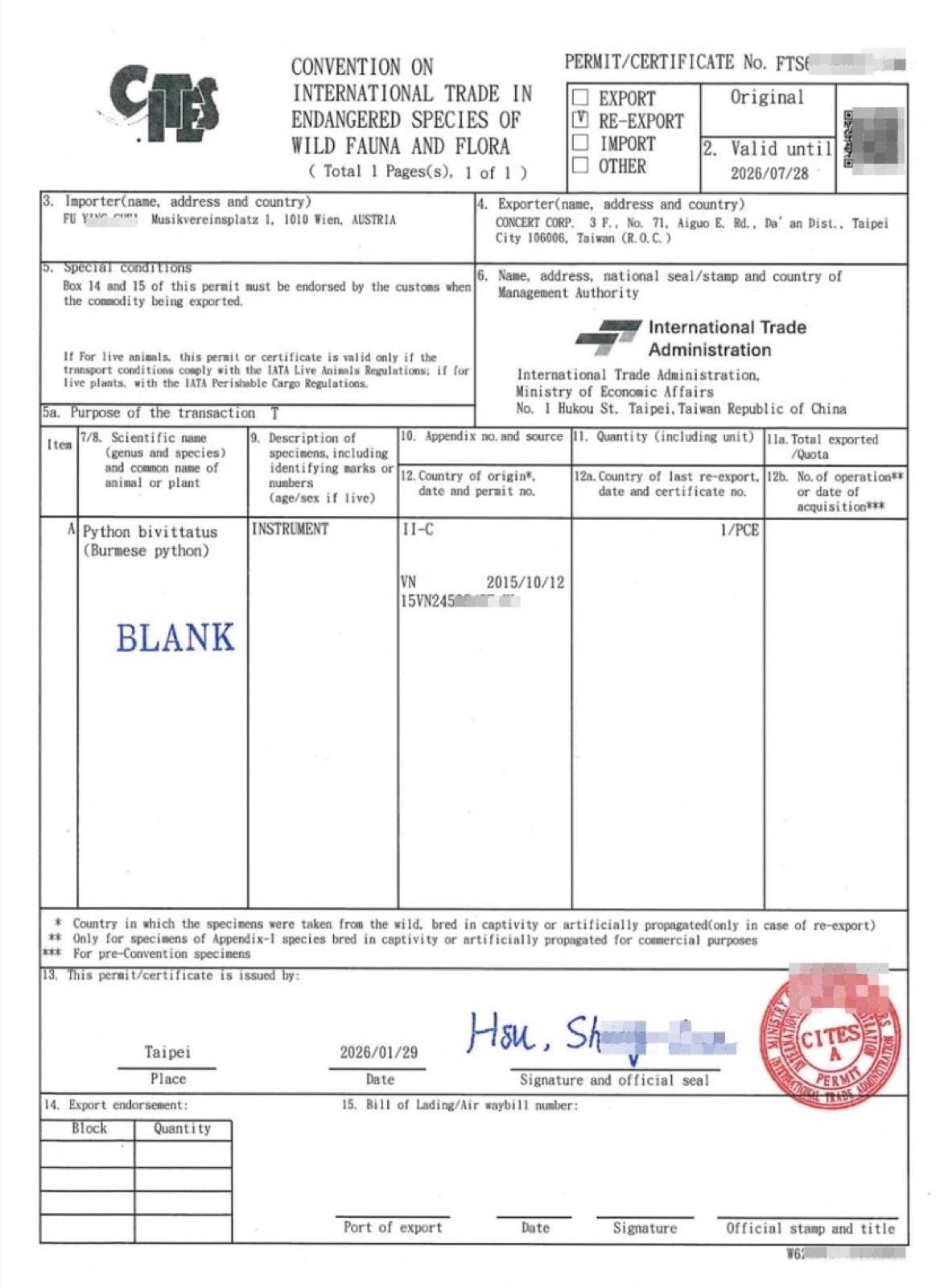
| Field | Value | Notes |
|---|---|---|
| Type | RE-EXPORT | Erhu was originally imported into Taiwan from Vietnam → now re-exporting from Taiwan |
| Validity | 6 months | From issuance date (this case: 2026/01/29 → 2026/07/28); covers the entire trip |
| Species | Python bivittatus | Burmese python |
| Source Code | II-C | II = CITES Appendix II / C = captive-bred specimens |
| Origin Country | VN (Vietnam) | Original CITES import record number from when the erhu first entered Taiwan (this case: 15VN2456S/CT-KL, issued 2015/10/12) |
| Exporter | Music store (Concert Corp.) | In practice, apply through a music store familiar with the process |
| Importer | Personal name + overseas address | This case: Vienna, Austria |
3. Application Process (Taiwan)
Issuing authority: Taiwan International Trade Administration (formerly Bureau of Foreign Trade)
Website: trade.gov.tw → Permit Services → CITES Species Trade Permit
Required Documents
- Application form (online or paper)
- Multi-angle photos of the instrument (body, python skin, bow)
- Original purchase records (invoice, import declaration)
- Original CITES import certificate (from when the erhu first entered Taiwan)
- Applicant passport copy
- Purpose of export (performance, personal carry, etc.)
- Destination country name and address
⏰ Timing
Processing typically takes 2-4 weeks, longer in peak season. Apply at least 1-2 months before departure. The permit is typically valid for 6 months, covering the entire trip.
4. Airline Logistics — Getting It On Board
💼 My Approach: Buy Business Class
The reasoning is simple — an erhu is absolutely not check-in baggage (baggage handling could destroy the skin and neck in one rough toss). But in economy class, the seat space and overhead bin dimensions can still cause crushing damage.
I chose to upgrade to business class for: wider seats, dedicated overhead compartments, and larger bin space. The erhu can sit safely without being pushed around. For a quality instrument or long-haul trip, the extra cost beats "instrument repair + unable to perform" by a wide margin.
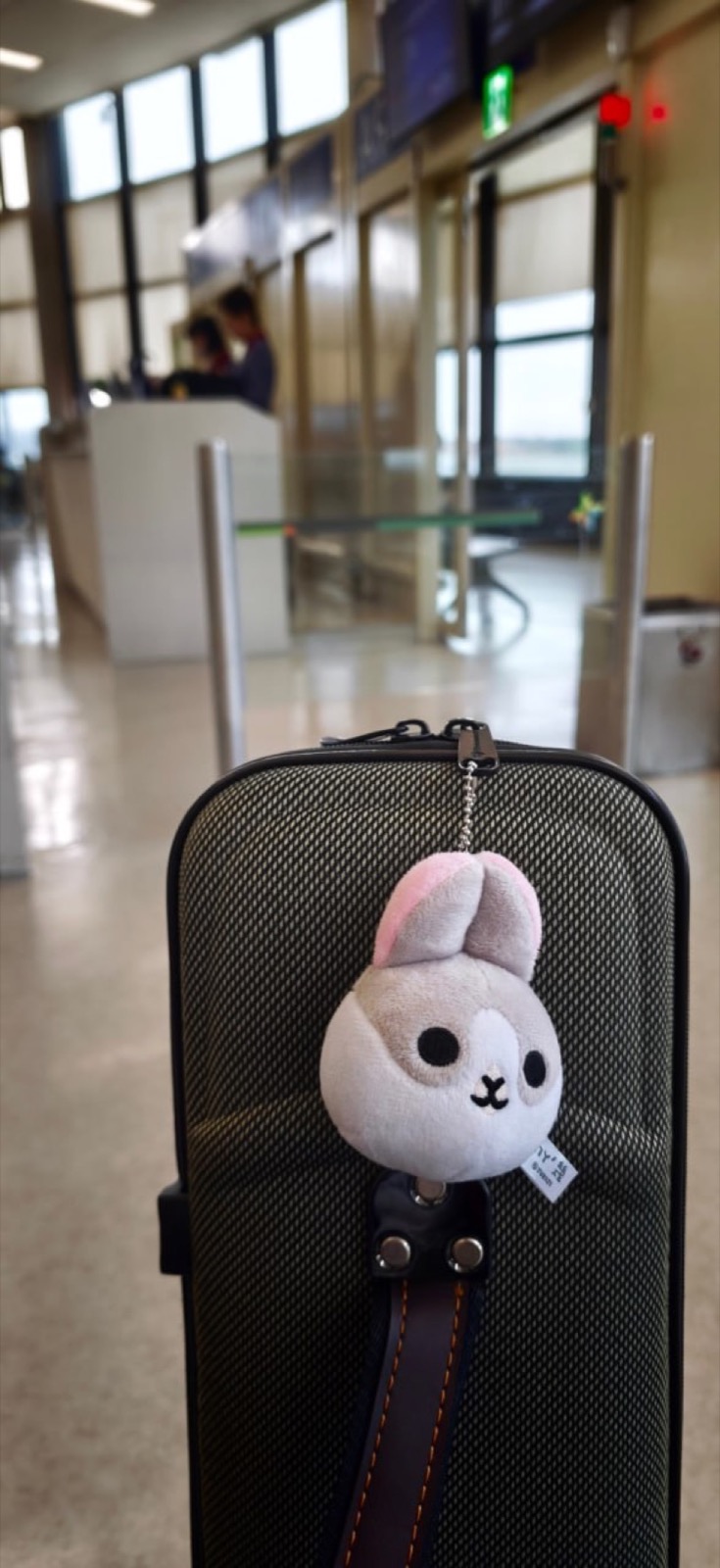
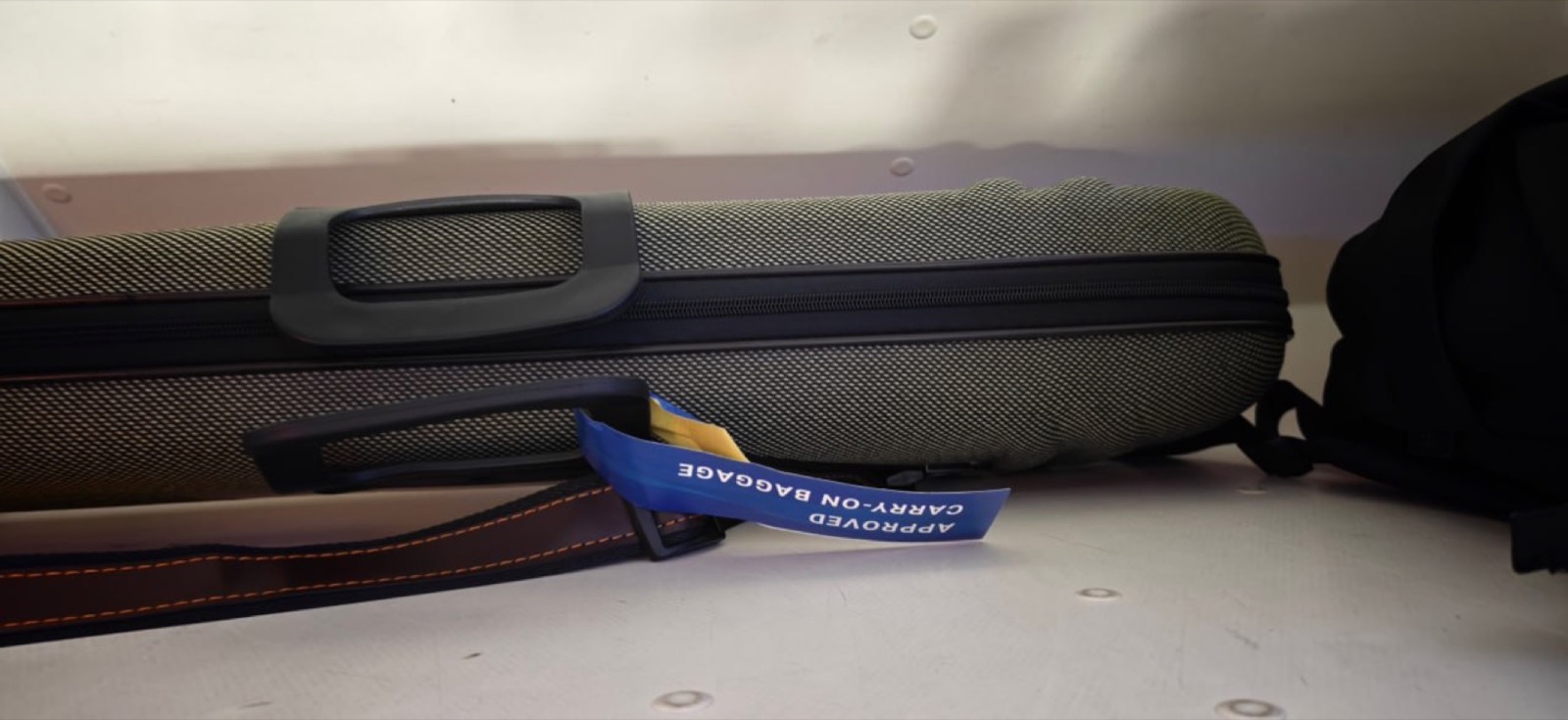
Airline Instrument Carry-On Policies
Policies vary widely by airline. Contact the airline customer service directly after booking — ask about "instrument carry-on specs / whether an extra seat (CBBG, Cabin Baggage seat) is required." Don't assume — always confirm in advance.
For US domestic flights or flights to the US: under FAA 14 CFR 121.589, instruments meeting size limits have a statutory right to carry-on. Other countries have no equivalent statute — depends on individual airline rules.
5. In the Cabin — Placement
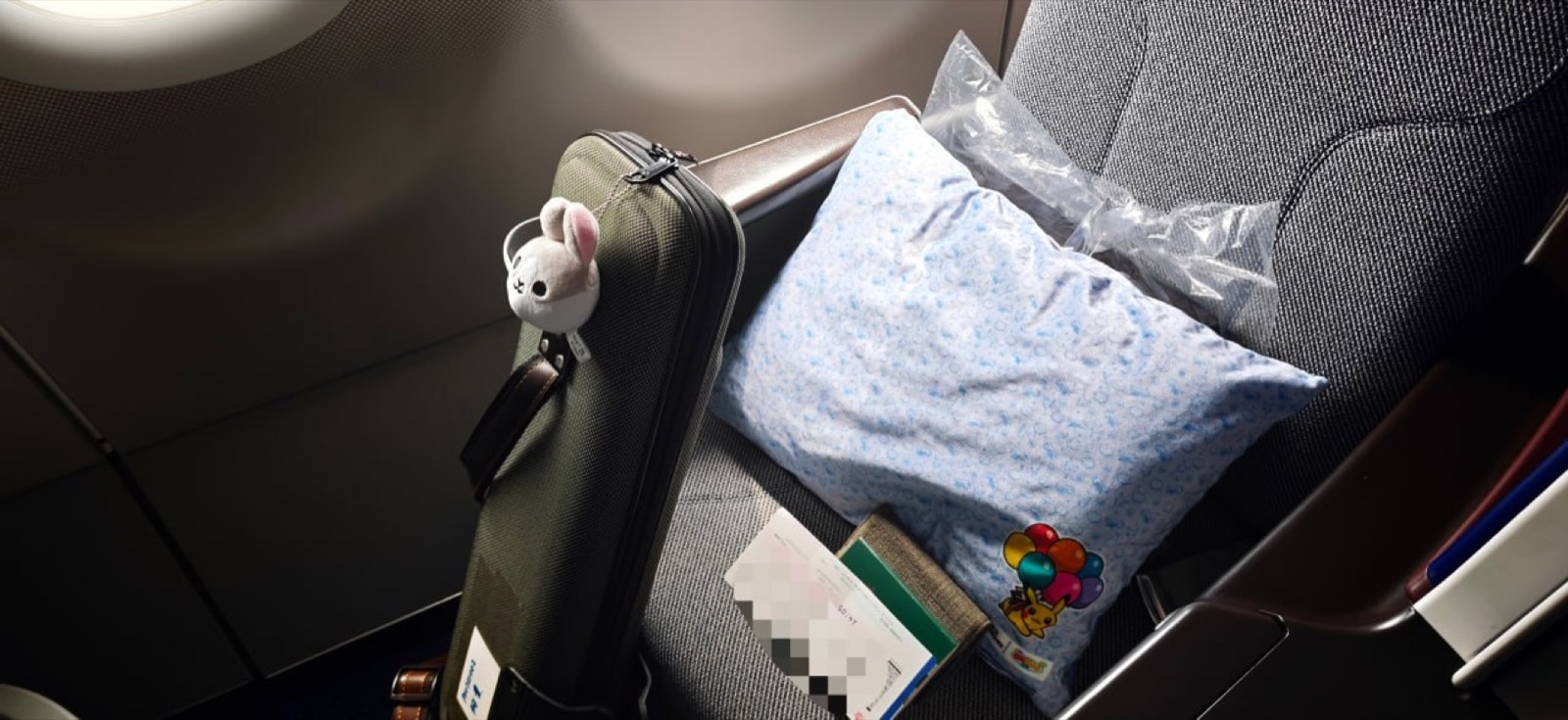
Before boarding, the erhu strings were slightly loosened (to avoid pressure-induced tension increase on the python skin).
6. Customs Crossings — Field Report
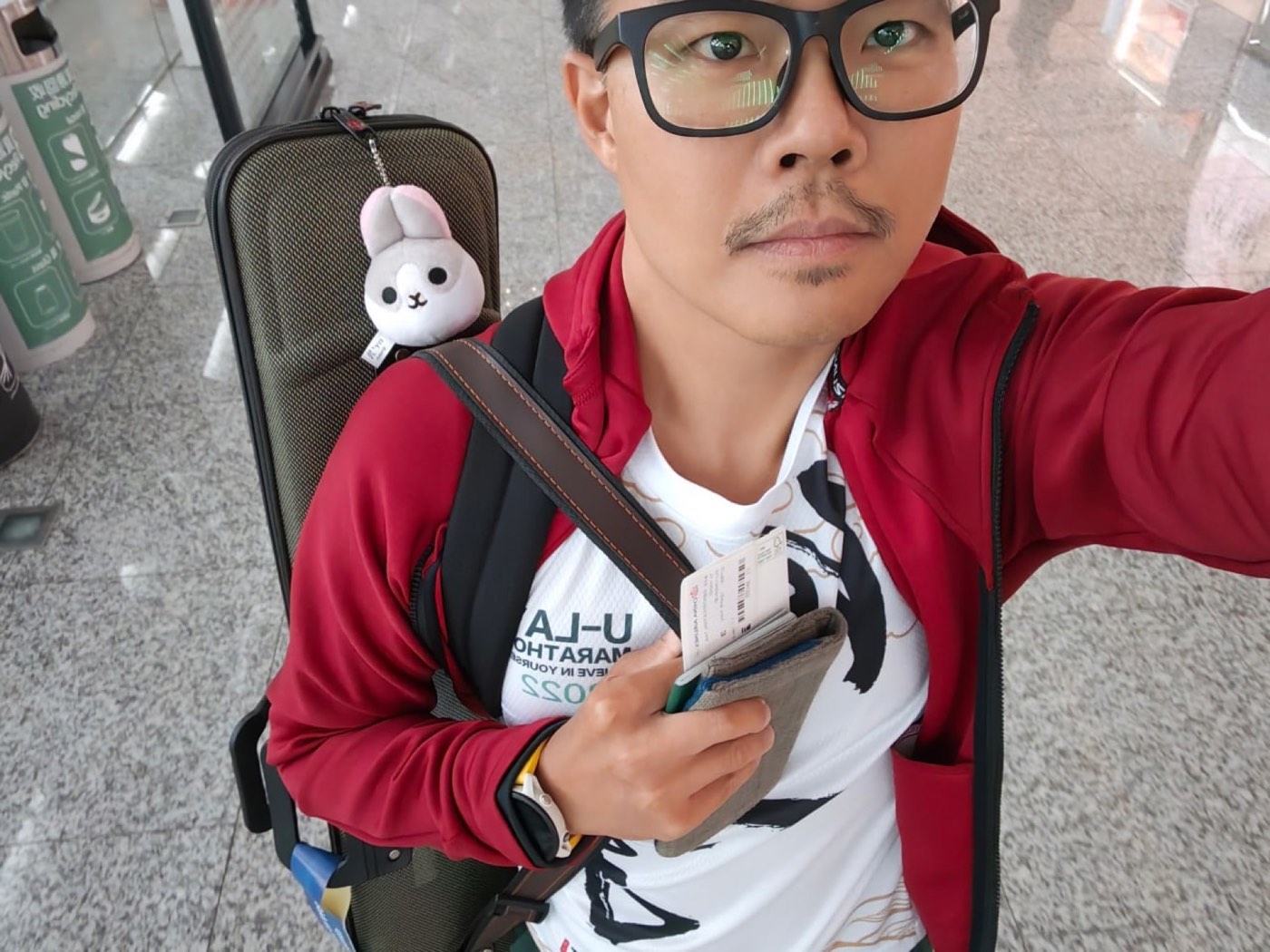
Customs / security checkpoints crossed this trip:
- TPE Taoyuan — Departure
- HAN Hanoi — Arrival + Departure (transit)
- TPE Taoyuan — Arrival (return leg)
- VIE Vienna — Arrival
- VIE Vienna — Departure
- TPE Taoyuan — Arrival
📋 What Actually Happened
- Customs only briefly confirmed "is it an instrument?" — the soft case shape is unmistakable; one question and through, no request to open the case for inspection
- Security took special care with placement — placed the case on the X-ray belt in a less-crushable position; staff specifically asked for gentle handling
- The CITES permit was never actually inspected this trip — no customs officer at any leg requested it
- But the permit is still mandatory — the cost of not having one is irreversible: caught at customs → instrument seizure, warehouse storage → even if eventually recovered, the python skin and neck likely already cracked from dry conditions
Conclusion: CITES is "insurance". The probability of being inspected is low, but caught without it = instrument written off. Spend ~US$ 10 in fees + 2 months of lead time to buy peace of mind for the unlikely-but-catastrophic case.
7. For Touring Musicians — Extra Considerations
- Performance contract instrument clauses: specify instrument specs, transport method, and insurance coverage
- Instrument-specific insurance: damage / theft (Allianz Musical Insurance or similar specialty providers)
- Local emergency contacts: local instrument repair specialist, music store, overseas cultural representative office
- Spare strings / qianjin: erhu-specific parts are hard to source in Europe — bring spares
8. Summary Checklist
| Timeline | Action |
|---|---|
| 2 months before | Confirm natural python skin → gather original CITES and purchase records |
| 6 weeks before | Submit CITES Re-export Permit application |
| 4 weeks before | Contact airline about instrument carry-on policy; confirm business class seat (if upgrading) |
| 1 week before | Prepare humidity packs for the case, spare strings, insurance document copies, CITES copies |
| Day of departure | Arrive 2 hours early at check-in; proactively inform ground staff about the instrument |
| Upon arrival | Keep CITES on hand; let the erhu acclimate to room temperature for 2-3 hours before playing |
| Return trip | Same — keep CITES copies ready; even if customs doesn't stamp, archive the documents |
This article documents an actual instrument-traveling experience in Spring 2026 (Taipei ⇄ Hanoi ⇄ Vienna, four-segment business class). CITES regulations may change by country and over time; before applying, refer to the latest announcements at cites.org and the Taiwan Trade Administration.